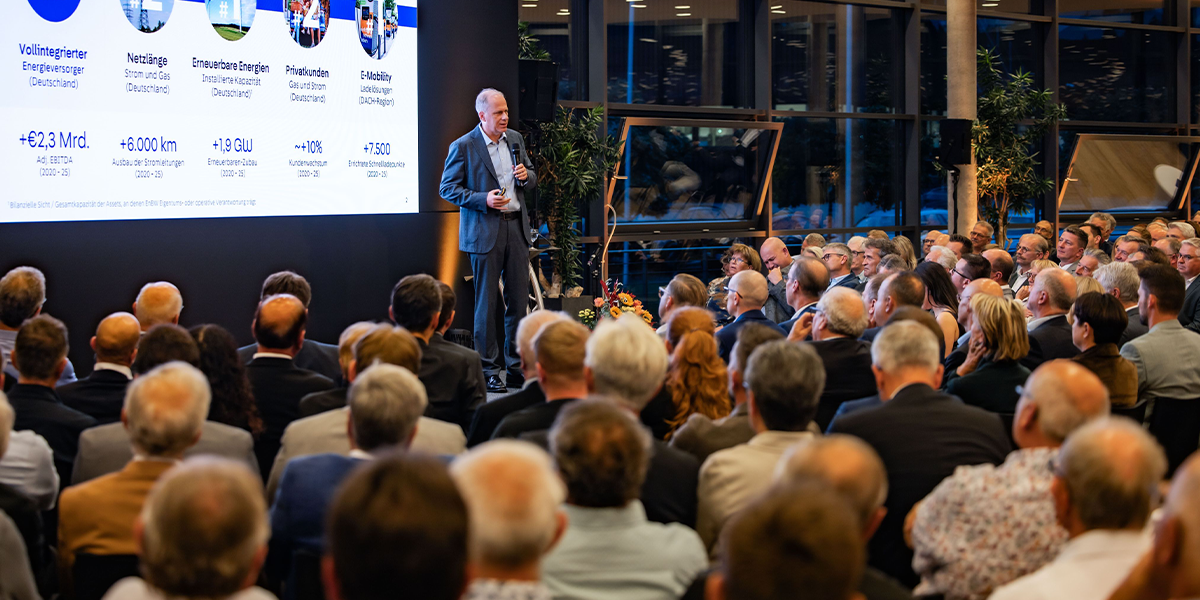
In her opening remarks, Miriam Häring, President of Anton Häring KG, emphasized the need to view the energy transition as a whole. The key to success, she explained, lies not in optimizing individual technologies in isolation, but in integrating them into a functional and affordable energy system. She also highlighted the importance of competitive framework conditions for Germany as an industrial location. For internationally operating companies, these conditions play a decisive role in investment decisions. At the same time, a strong industrial sector is essential to financing and driving the transformation forward. The challenge, therefore, is to make the energy system more economically efficient in the long term rather than permanently offsetting high costs through government subsidies.
In his presentation entitled “Taking a Holistic Approach to the Energy Transition: How We Can Secure Affordable Energy for Germany as an Industrial Location,” Dr. Georg Stamatelopoulos outlined how the transformation of the energy system can be successfully implemented in the long term.
His presentation focused on three key objectives of the energy transition: affordability, climate protection and security of supply. Balancing these objectives is essential to ensuring an efficient and competitive energy supply over the long term.
The EnBW CEO outlined his company’s extensive investments in renewable energy, the expansion of electricity grids and charging infrastructure. At the same time, he made it clear that expanding renewable energy generation capacity alone would not be sufficient. What matters is the interaction of various measures: efficient electricity grids and faster grid connections, additional flexible generation and storage capacities, and smarter management of electricity consumption.
Hydrogen-ready gas-fired power plants, in particular, could help ensure a reliable energy supply during periods of low wind and solar power generation. At the same time, digitalization offers new opportunities to better align peak electricity demand with the availability of renewable energy. Alongside the continued expansion of renewable energy, economically viable framework conditions are also essential.
Another key focus of the presentation was the economic efficiency of the energy transition. Drawing on the findings of a system cost study commissioned by EnBW, Dr. Stamatelopoulos illustrated the potential savings that could be achieved by developing the energy system in closer alignment with actual demand.
The objective, he emphasized, is not to question climate protection targets, but to make the overall transformation more efficient. The expansion of renewable energy, electricity grids, storage facilities and reliable generation capacities must be better coordinated. Such a holistic approach could help reduce costs while ensuring security of supply.
An example from the Heuberg region demonstrated that a holistic approach is also becoming increasingly important at the regional level. Miriam Häring referred to the activities of Heuberg Energie GmbH, through which municipalities and companies are working together to develop future-oriented energy concepts. In Bubsheim, for example, a project is being pursued that combines photovoltaics, battery storage and the direct supply of energy to an industrial company.
Although such regional initiatives cannot solve the broader challenges of the energy transition on their own, they demonstrate the opportunities created by intelligently combining different technologies. The subsequent discussion highlighted shared priorities between the energy sector and industry, particularly regarding the expansion of grid infrastructure, greater flexibility within the energy system and the need to ensure competitive energy prices.
“The energy transition will only be successful in the long term if it gives equal consideration to affordability, climate protection and security of supply. For Germany as an industrial location, the priority now is to further develop the energy system in a pragmatic and efficient manner,” said Dr. Georg Stamatelopoulos.
With the Innovation Forum, Anton Häring KG continues its long-standing series of events. The aim is to bring together leading figures from business, politics, science and society with regional representatives and encourage dialogue on key issues shaping the future. The 46th Innovation Forum demonstrated that a successful energy transition depends not only on the expansion of renewable energy, but above all on the effective integration of all components of an efficient, secure and affordable energy system.